
Perikles
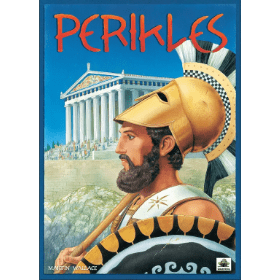 Perikles is a game from Martin Wallace. Players assume the role of a noble family seeking to become the leader of one or more of 6 ancient Greek city-states. The game plays out in two phases:
In the first, players vie for area control in each of the six states, which end in elections. Players who win the election in each state can then control that state's army.
In the second phase, players use cards to move their armies to attack or defend one of seven battles (each tied to a state, and you can't attack your own!) that are up for grabs that round.
The gameplay mechanic is straightforward, with elements drawn from other Euro-style wargames (especially Martin Wallace's Struggle of Empires). What makes Perikles unique is the smooth integration of the area control/voting phase and the military phase.
Počet hráčů: 3 - 5
Trvání hry: 17 mn
Složitost: 4 / 5
Hraj Perikles a 1394 dalších her online.
Žádné stahování, hraj přímo ve webovém prohlížeči.
S tvými přáteli a tisíci hráči z celého světa.
Zdarma.


Hraj Perikles a 1394 dalších her online.
Žádné stahování, hraj přímo ve webovém prohlížeči.
S tvými přáteli a tisíci hráči z celého světa.
Zdarma.
Přehled pravidel
Perikles
In Perikles, players represent influential Greek families. Over three epochs, they strive to gain political control in six city-states and lead the armies of these cities to victory in various battles.
Game Objective
Win by accumulating the most Victory Points (VP). Points are awarded at the end of each epoch for won battles (Statue tokens) and at the end of the game for controlling city-states.
Game Flow
The game is played over three epochs. Each epoch consists of two main phases: the Political Phase and the War Phase.
1. Political Phase (Influence & Control)
During this phase, players place their influence cubes to take leadership of the cities.
- Selecting Influence Tiles: Players take turns picking tiles that indicate which cities they can place cubes in.
- Placing Cubes: Cubes are placed in the six cities (Athens, Sparta, etc.).
- Elections: In each city, the player with the most cubes is checked.
- The player with the most cubes becomes the Leader of the city for that round.
- They receive the city's two Army Tiles (Land and Sea forces).
- Specific tie-breaking rules apply if necessary.
- Ostraka (Exile): Players can attempt to remove opposing cubes from cities to secure a majority.
2. War Phase (Battles & Strategy)
The leaders of the cities now deploy their armies to launch attacks against Persia or other Greek locations on the board.
- Deploying Armies: Players place their Army Tiles face-down on available locations. Battles are categorized as Land or Sea combat.
- Resolving Battles: Tiles are revealed. Combat is resolved by comparing combat strength (Strength values on tiles + a die roll).
- Attacker vs. Defender: The attacker must overcome the location's defense or the opposing armies present.
- Casualties: Defeated units are removed from the board.
- Rewards: The winner of a battle receives a Statue token, which provides VP at the end of the epoch.
Actions & Decision Factors
Influence Tile Categories
Tiles offer various tactical options:
- City Symbols: Allow placing 1 or 2 cubes in the corresponding city.
- Event Tiles:
- Plague: Reduces the number of cubes in a chosen city for all players.
- Treachery: Allows weakening or manipulating an army in battle.
- Persian Fleet: Can be used in sea battles to influence the outcome.
Military Units
- Hoplites (Land): Used for land battles in the regions.
- Triremes (Sea): Used for naval battles to secure control over the seas.
- Sparta Special Rule: Spartan land units are exceptionally strong in combat but have less political flexibility.
End of Game & Scoring
Final scoring takes place after the third epoch:
- Statue Points: Sum of points from all three epochs.
- City Control: Players holding leadership in a city at the end of the third epoch receive bonus VP based on the city's value.
- Remaining Influence: Minor points for leftover resources.
The player with the most total Victory Points is the winner.